

Three activists who once organised annual vigils to mark the 1989 Tiananmen crackdown crackdown have been sentenced to up to seven years and three months in prison.
 The Tiananmen vigil in Victoria Park on June 4, 2018. Photo: Anthony Wallace/AFP.
Appearing before a panel of designated judges at the West Kowloon Law Courts Building on Friday, Chow Hang-tung, Lee Cheuk-yan, and Albert Ho were handed the jail terms for inciting subversion under the Beijing-imposed national security law.
Lee received a jail sentence of seven years, Chow was jailed for seven years and three months and Ho – who pleaded guilty – received a sentence of five years and two months imprisonment.
 The Hong Kong Tiananmen crackdown vigil on June 4, 2019. Photo: Todd R. Darling/HKFP.
The trio formerly led the Hong Kong Alliance in Support of Patriotic Democratic Movements of China, a now-defunct activist group that held annual vigils to remember the Tiananmen dead. The Alliance itself was handed a fine of HK$1.5 million on Friday, to be paid within three months.
The Tiananmen crackdown occurred on June 4, 1989, ending months of student-led demonstrations in China. It is estimated that hundreds, perhaps thousands, died when the People’s Liberation Army cracked down on protesters in Beijing.
 A Correctional Services van outside the West Kowloon Law Courts Building on Friday, September 11, 2026, ahead of the sentencing of Tiananmen vigil activists Chow Hang-tung, Lee Cheuk-yan, and Albert Ho. Photo: Kyle Lam/HKFP.
The group held the mass candlelit vigils until the event was banned in 2020, with the government citing pandemic curbs, and again the following year. They voted to disband in September 2021.
Friday’s ruling said that the present case did not involve violence or the threat of violence, “nor had the defendant put forward any specific means of implementation or timetable” to end one-party rule in mainland China – one of the Alliance’s central tenets. Nevertheless, the court still found that the offence was “of a serious nature.”
That placed the defendants within the higher of the two sentencing bands under the Beijing-imposed national security law, it added.
 Police gathered outside the West Kowloon Law Courts Building on Friday, September 11, 2026 ahead of the sentencing of Tiananmen vigil activists Chow Hang-tung, Lee Cheuk-yan, and Albert Ho. Photo: Kyle Lam/HKFP.
According to the ruling’s press summary, the court reiterated that the National Security Law (NSL) “had no retrospective effect” and that the trio were convicted solely on the basis that they had violated the legislation.
But the judges also said that the court would consider the broader social context “as part of the overall background of the case.” Plus, they took into account how the Alliance had publicised its agenda across activities, including the annual Tiananmen remembrance vigils, as well as on various social platforms. They also considered how the defendants’ activities had lasted for as long as 14 months.
Additionally, the court also noted that the defendants possessed a certain degree of mobilising power and influence in Hong Kong and that their activities had a citywide reach: “Despite the defendants[‘] beliefs that their agenda might be in breach of the constitution and the NSL they recalcitrantly pursued their course of conduct which was premeditated.”
 Police gathered outside the West Kowloon Law Courts Building on Friday, September 11, 2026 ahead of the sentencing of Tiananmen vigil activists Chow Hang-tung, Lee Cheuk-yan, and Albert Ho. Photo: Kyle Lam/HKFP.
In its ruling, the court said that Chow had declined to call her submission a mitigation statement and maintained that she was innocent.
At a mitigation hearing last month, Chow said that the court’s decision to convict her under the national security legislation amounted to saying that “pursuing democracy is a crime.”
See also: Tiananmen vigil activist Chow Hang-tung’s mitigation after guilty verdict in national security trial
“She could not analyse the case from an offender’s perspective regarding whether it was ‘minor’ or ‘serious’,” the ruling said. “[Chow] stated her words and deeds stemmed from her democratic convictions, aimed at pursuing ideals and doing what benefited Hong Kong, without ill motives. She felt no wrongdoing or regret and affirmed she would steadfastly adhere to her beliefs,” it read.
Verdict condemned and lauded
Last month’s ruling against the activists was condemned by rights groups and the United Nations, but lauded by the local government. The incitement of subversion offence carries a maximum penalty of 10 years in prison.
Chow and Lee have been already held in detention for around five years. They were found guilty last month, alongside the Alliance itself, with the judges saying they had “all along been hostile towards the [Chinese Communist Party] and the Central Government under its leadership.”
 Police gathered outside the West Kowloon Law Courts Building on Friday, September 11, 2026 ahead of the sentencing of Tiananmen vigil activists Chow Hang-tung, Lee Cheuk-yan, and Albert Ho. Photo: Kyle Lam/HKFP.
Ho – the only one of the trio to plead guilty – had been remanded for three years and six months.
In a mitigation hearing last month, barrister Erik Shum, representing Lee and Ho, asked the court to place the two activists in the lower of the two sentencing bands for the offence, saying they had been convicted of an inchoate offence with no premeditation, roadmap, or timeline.
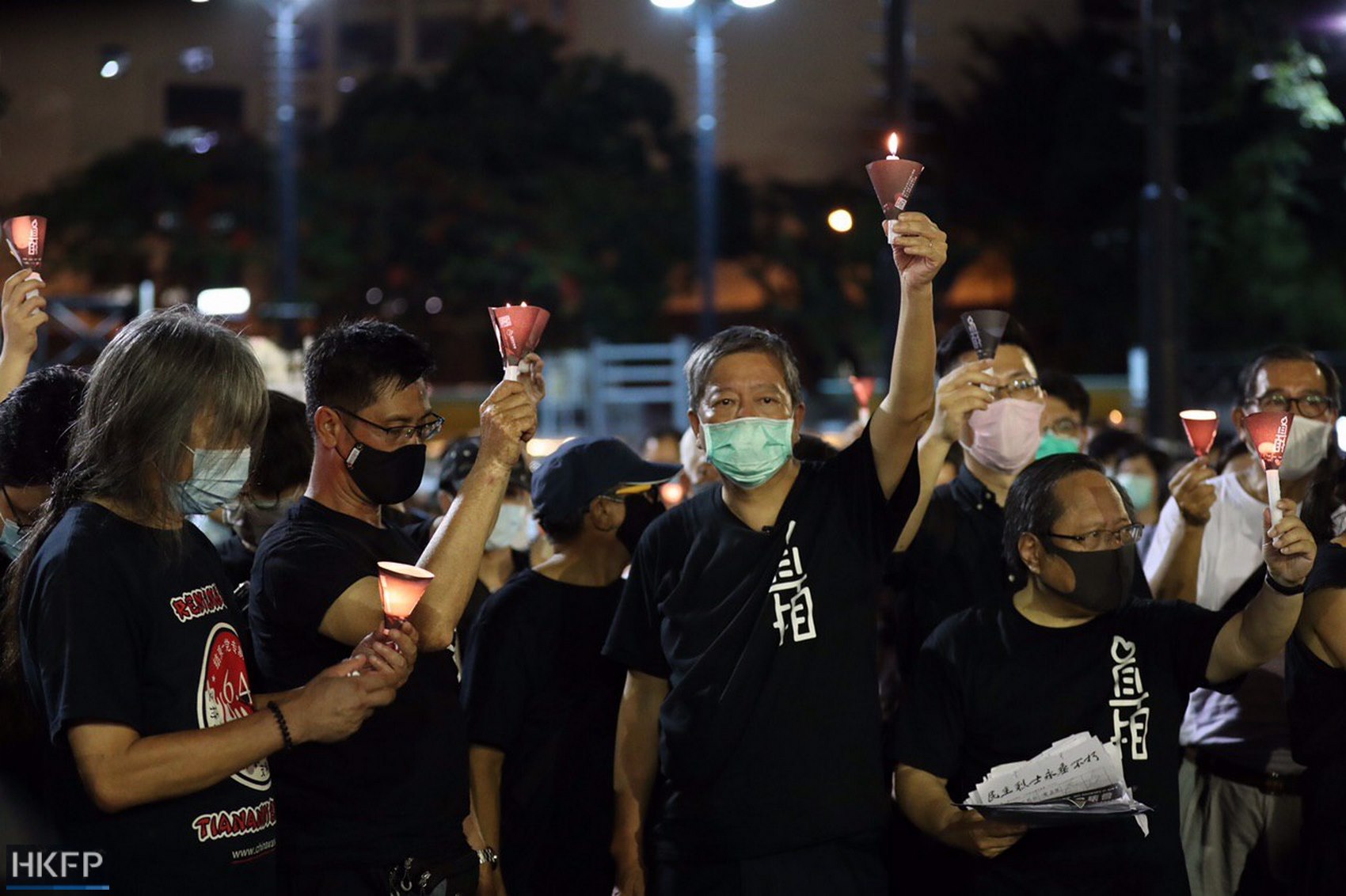 The annual vigil at Victoria Park on June 4, 2020, to commemorate victims of the 1989 Tiananmen Square Massacre. Photo: May James/HKFP.
“Whether the incitement led to substantial destruction is a very important sentencing factor,” Shum said.
 English (US) ·