
 3 months ago
53
3 months ago
53
A month after Donald Trump issued an executive order purporting to designate antifa as a domestic terrorist group, an intelligence unit inside the Miami-Dade Sheriff’s Office in Florida sent out a confidential bulletin.
Trump’s announcement was widely criticized as a legally baseless attempt to criminalize his enemies on the left, but the Southeast Florida Fusion Center took it very seriously.
Citing sources that included right-wing social media accounts, the bulletin described antifa as a “decentralized autonomous network of cells” that “stand against capitalism and want to overthrow governments they feel are oppressive through violence and silence their opposition by any means necessary.”
“Antifa has been very active, their most prevalent presence during the George Floyd riots and recently during the anti-ICE protests,” it said, citing the 2020 national uprising against police brutality and the protests against U.S. Immigration and Customs Enforcement that followed Trump’s rise to power.
The Miami-Dade bulletin went on to describe the National Lawyers Guild — a left-leaning collective once villainized by Joseph McCarthy — as the “legal representative” of antifa. It also warned about the danger of zines as tools to “recruit new sympathizers” and of inflatable animal costumes as a “form of propaganda implemented by Antifa to soften their image.”
It was just one example of how, as the administration accelerates its crackdown on left-wing organizers, Trump’s push to paint antifa as a terror group has seeped into local law enforcement.
Previously unreported documents obtained by The Intercept show how local fusion centers are borrowing the tone and some of the language of Trump’s invectives against the left. They draw on his September 22 executive order designating antifa as terrorists and on prosecutions launched after a similar but more wide-reaching directive issued three days later, known as National Security Presidential Memorandum 7, or NSPM-7.
“The tone set by leadership is important,” Brendan McQuade, a University of Southern Maine professor who studies fusion centers and domestic surveillance, said of the documents obtained by The Intercept. “In the Trump administration the incentive structure is clear: Trump wants to mobilize the security apparatus against his perceived enemies, and in some sense the FBI and the Florida fusion center are both responding to that incentive structure.”
A White House spokesperson said the administration’s approach was part of a “new law enforcement strategy.”
“The President’s Memorandum is focused on investigating, disrupting, dismantling, and prosecuting individuals and entities engaged in organized political violence and domestic terrorism,” said White House spokesperson Abigail Jackson. “The Trump Administration will get to the bottom of this vast network inciting violence in American communities.”
The Florida Report
The Florida report was among a trove of scores of such documents obtained by The Intercept that were distributed through a national network of fusion centers.
Fusion centers were created after the September 11, 2001, attacks to facilitate information sharing about terror threats between federal and local law enforcement. Independent reviews, however, have found few tangible results after more than two decades in operation and countless dollars of federal funding for the centers. Critics say they have often been used to cast dissent as suspicious.
Many of the fusion center memos and bulletins focus on mundane topics of interest to local cops, such as the latest trends in ATM card “skimming.”
Others focus on foreign terror threats, such as the latest edition of “Inspire,” Al Qaeda in the Arabian Peninsula’s magazine.
Some of them, however, echo the Trump administration’s obsession with the left.
The Florida report, which is marked “for official use only,” stretches 28 pages. It starts off by defining antifa as terrorism and stating that the “goal of Antifa is the violent overthrow of the United States government.” (The Miami-Dade Sheriff’s Office, which houses the Southeast Florida Fusion Center, did not respond to a request for comment.)
Then it reproduces in full Trump’s executive order claiming to designate antifa as a “domestic terrorist organization” — a power he would not have even if antifa were a well-defined group rather than an ideology or movement.
Throughout, the Florida report leans heavily on right-wing sources, including the journalist-provocateur Andy Ngo, the Pizzagate conspiracy theorist Jack Posobiec, and an X account called Far Left Watch.
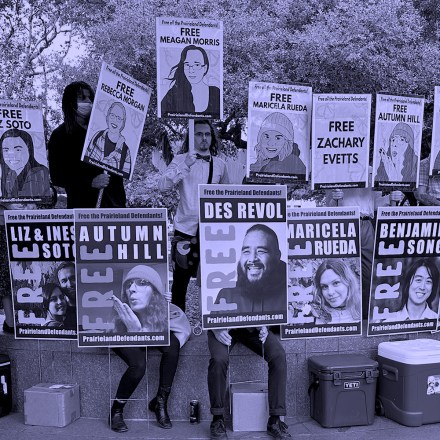
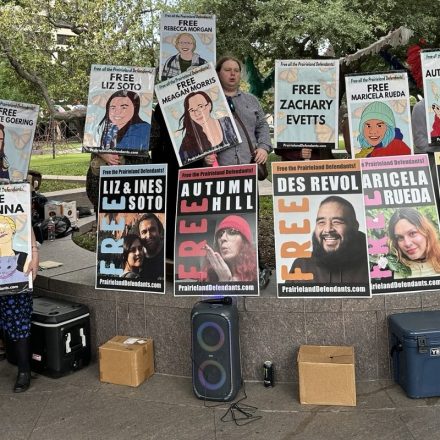
The report casts a wide variety of First Amendment-protected activities as antifa tactics, including using “profane language against law enforcement” and “doxing.” It warns that zines are used as “educational tools and offered as propaganda to recruit new sympathizers” — echoing an argument that federal prosecutors used against the defendants in the Prairieland ICE detention center protest case.
Police, the Florida report says, should also be on the lookout for inflatable animal costumes, in an apparent reference to the Portland Frog Brigade: “This is a form of propaganda implemented by Antifa to soften their image and change the narrative that they are a violent domestic terrorist organization.”
The document’s tone and reliance on partisan sources make it read “like opposition research,” McQuade said.
“This is not an intelligence bulletin about an organization,” he said. “This is like a target package that, to me, is encouraging police to go hunting for a very broad profile of not even just dissent but sometimes aesthetic markers of dissenting behavior.”
Target: Lawyers
The report devotes a full page to the National Lawyers Guild, the legal collective founded in 1937 as a colorblind alternative to the American Bar Association, which forbade Black members.
The group’s leftist sympathies have long drawn the ire of the right. In the 1940s and 1950s, it was infiltrated by J. Edgar Hoover’s FBI and mentioned in McCarthy’s infamous Senate hearings. More recently, the group has become an obsession for right-wing think tanks such as the Center for Security Policy and the Capital Research Center.
The Florida fusion center casts the National Lawyers Guild’s efforts to observe police on the streets and defend protesters in court in sinister terms, calling it antifa’s “legal representation.” That is laughable, said Xavier de Janon, director of mass defense for the National Lawyers Guild.

“I don’t know what that means, because antifa is not an organization,” he said, adding that if it were true, the group would proud to fight fascism. “But again, it’s false. It’s just not based on truth. There is no retainer agreement with antifa.”
And beyond that, he said, “NLG as an organization does not provide legal representation. Its members do.”
The report included a picture of National Lawyers Guild legal observers wearing their trademark lime-green hats, which de Janon interpreted as essentially a call to target them.
Pro-Palestine Groups
While the Florida report drew heavily from White House messaging, a different report from Texas relies on court filings from the Justice Department.
In December, the Dallas Regional Fusion Center produced an “intelligence brief” centering on the Turtle Island Liberation Front, a left-wing group accused of plotting coordinated bombing attacks in southern California.
The small group appears to have been thoroughly infiltrated by a paid informant and an FBI agent. The Dallas fusion center argued for even more surveillance, citing a “tangible and immediate threat from newly formed, violent extremist cells that require enhanced monitoring and inter-agency coordination.”
Corbin Rubinson, a spokesperson for the Dallas Police Department, which houses the fusion center, declined to comment on the report.
“These assessments are developed to support information sharing and situational awareness among our public safety partners, and we do not discuss their contents or how they are developed,” Rubinson said.
The Dallas document went on to name two groups that have no apparent connection to the Turtle Island Liberation Front: Direct Action Movement for Palestine Liberation and Unity of Fields. The only connection to the Turtle Island Liberation Front was that each group could be described as, in the words of the report, “another far-left, pro-Palestine, anti-Zionist extremist group.”
The bulletin acknowledged that none of the groups it singled out had a known presence in Dallas. Still, it urged police in the Dallas–Fort Worth area to “Monitor social media pages for extremist groups using ghost accounts and/or VPN” and to “Expand monitoring of encrypted messaging platforms for extremist activity.”
Anarchists in Minneapolis
The Miami and Dallas reports cribbed extensively from Trump’s executive order and Justice Department court filings, respectively. In January of this year, the FBI put out an alert more explicitly directed at local police.
Four days after federal officers shot and killed nurse Alex Pretti in Minneapolis, the FBI issued a “public safety awareness report” produced by its Office of Partner Engagement and Counterterrorism Division. The report, which was first made public last week by the news outlet Prism, was independently obtained by The Intercept.
The January 30 report was titled “Anarchist Violent Extremists Pose Persistent Public Safety Threat.” It ticked off recent instances of what the FBI saw as instances of anarchist violent extremism, or AVE, including the Prairieland ICE detention facility protest near Dallas and the Turtle Island Liberation Front. Then it swiveled to Minneapolis, which for weeks had been the scene of ordinary protesters confronting masked federal agents.
“Given recent criminal activity in Minneapolis, Minnesota, the FBI is concerned about the potential for AVE violence there,” the report said. “The FBI has seen indicators of this, to include an individual who self-identified as Antifa advocating on social media for violence against ICE in Minneapolis, telling people to ‘get your guns.’ The FBI investigates any reports of violence or the threat of violence by AVEs or other domestic violent extremist or criminal actors.”
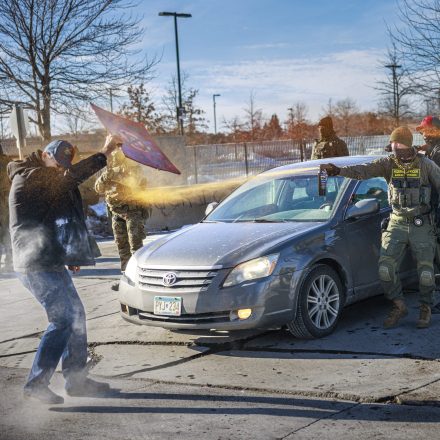
The reference about a “self-identified” antifa member appears to be to Kyle Wagner, a Minneapolis man whose online videos featured prominently in the recent indictment of 15 anti-ICE protesters there.
The entire FBI report has a more professional tone than the Florida fusion center bulletin, McQuade said, but it rests on equally thin evidence.
“The FBI talks about two criminal cases, some social media monitoring, but they have claims that would not pass peer review — that anti-capitalist graffiti is an indicator of threat,” he said. “Then the little pull box they had in there about Minneapolis, where one tweet or social media post is interpreted to mean the whole city is ready for violence against federal agents. That just seems like bad analysis.”

Dissent as a Threat
It is not the first time that counterterrorism agencies have mobilized against the left on thin evidence.
Months before Trump supporters stormed the Capitol on January 6, 2021, The Intercept obtained hundreds of hacked law enforcement materials showing agencies obsessing over the threat from the left while ignoring the burgeoning right-wing, anti-government boogaloo movement. Adherents of the movement played a role in the assault on the Capitol.
In 2024, the American Civil Liberties Union filed a public records lawsuit against the Justice Department seeking internal documents about how Joint Terrorism Task Forces and fusion centers responded to protests.
Skeptics of domestic counterterrorism agencies say the overreach has spanned both Democratic and Republican White House administrations, but the documents the ACLU obtained from the first Trump administration share remarkable similarities with his second term.

The January 2026 bulletin from the FBI obtained by The Intercept includes a warning about “black bloc” clothing used to obscure demonstrators’ identities, securing financing through “lawful donations,” encrypted messaging apps, and anti-government graffiti.
The ACLU, meanwhile, obtained a July 2018, bulletin produced by the Department of Homeland Security and local fusion centers that warned about “potential indicators of violent activity by anarchist extremists at events and protests in the homeland.”
The “indicators” of a heightened threat in the bulletin include wearing black and red clothing, soliciting legal defense donations ahead of protests, wearing “Guy Fawkes” masks, and “use of public transportation” to mask license plate information.
The “indicators” of a heightened threat include wearing black and red clothing, wearing “Guy Fawkes” masks, and “use of public transportation.”
“Merely wearing certain colors and taking the bus to a protest should not be enough to justify heightened scrutiny from law enforcement,” Sara Robinson, an attorney with the ACLU’s National Security Project, said in an emailed statement. “Using overly broad and stigmatizing terms to describe people who may be engaged in First Amendment-protected activity opens the door to pretextual law enforcement investigations and aggressive policing based not on evidence of criminal activity, but on the exercise of free speech rights.”
She said, “The Trump administration is continuing to treat dissent as a threat.”
The post How Local Cops Are Running With Trump’s NSPM-7 Attacks on Antifa appeared first on The Intercept.
 English (US) ·