

Former Hong Kong chief executive Tung Chee-hwa has died at the age of 89.
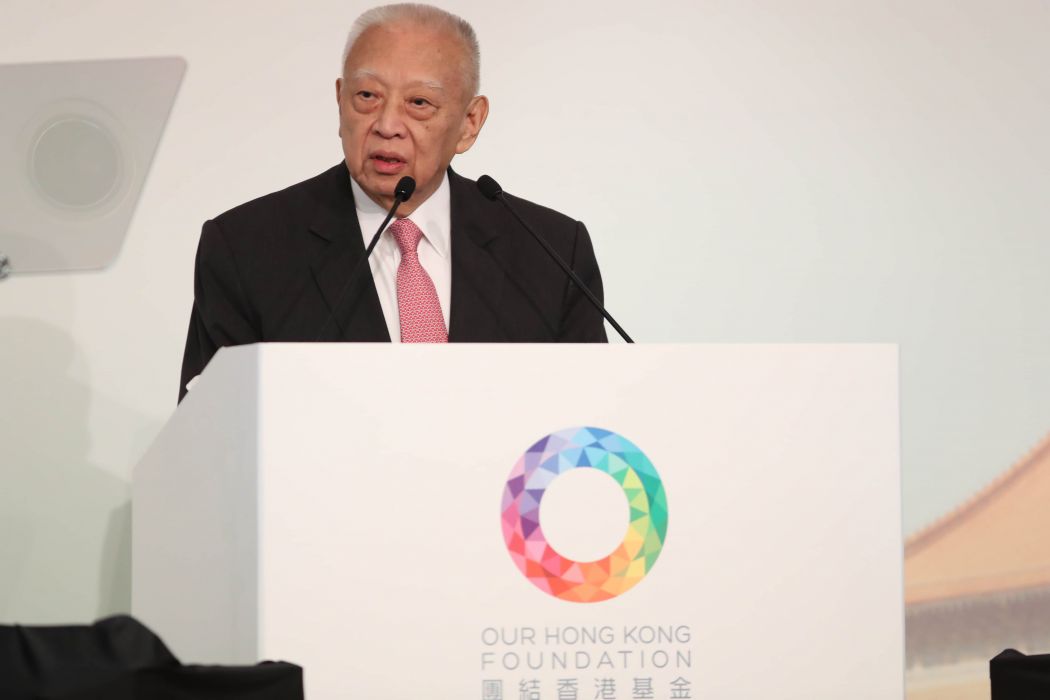 Tung Chee-hwa. Photo: Our Hong Kong Foundation.
The city’s first leader following its 1997 Handover from Britain passed away peacefully on Tuesday, according to his office.
Tung resigned in 2005 citing health reasons, and was succeeded by his chief secretary Donald Tsang.
Born in Shanghai in July 1937, Tung was the son of shipping magnates Tung Chao-yung and Koo Lee-ching. The family ran Orient Overseas (International) Limited, a shipping and logistics enterprise and moved to Hong Kong when Tung was a child.
Following his studies at the University of Liverpool in the UK, he became involved in politics when Hong Kong’s last British governor Chris Patten appointed him as a non-official member of the Executive Council.
defeated two opponents in the first small-circle leadership election in December 1996, Tung became the Special Administrative Region’s first chief executive.
Financial crisis and SARS pandemic
His administration was marred by controversies and crises. Soon after he assumed power, Hong Kong was hit by the Asian financial crisis which began in July 1997.
 Photo: HKFP/Ellie Ng.
While it was able to fend off speculators, the city’s economy suffered again in 2003, when SARS broke out and claimed the lives of 299 people.
Article 23 mass demo
Some of Tung’s policies drew fierce criticism. He faced a political crisis in 2003 when the government sought to legislate the city’s own security law in accordance with Article 23 of the Basic Law.
The plan was met with fierce opposition across society. On July 1, 2003, an estimated 500,000 people marched on the streets.
 Local residents hold anti-Tung poster during an anti-Article 23 protest in Hong Kong, 01 July 2003. Ten of thousands of people took to the streets for a huge protest march against a controversial anti-subversion law to coincide with the sixth anniversary of the territory’s reversion to Chinese rule. Photo: Thomas Cheng/HKFP.
The proposal was eventually opposed in the legislature and postponed indefinitely by the government. It led to the resignation of then-secretary for security Regina Ip, but was eventually passed into law in 2024 by the “patriots only” legislature.
Retirement
Following Tung’s resignation in 2005, he was appointed to the Chinese People’s Political Consultative Conference, China’s top political advisory body.
In 2014, Tung set up the Our Hong Kong Foundation following the 2014 pro-democracy Umbrella Movement demonstrations. According to the foundation’s website, the organisation “aims to harness the collective wisdom of Hong Kong’s talents and contribute to long-term and sustained prosperity and stability of Hong Kong under the “One Country, Two Systems” principle.”
Though understood to be influential behind the scenes, Tung had largely disappeared from public events in recent years.
Additional reporting: Candice Chau and Tom Grundy.
 English (US) ·